
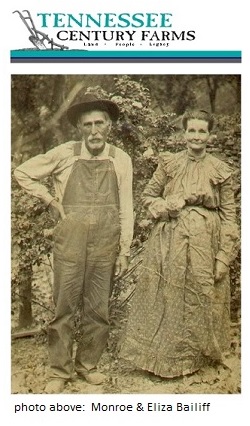

J.M. Bailiff Farm Celebrates 150 Years
of Family Legacy and Agricultural Heritage
The J.M. Bailiff Farm in Possum Hollow near Dowelltown, Tennessee, celebrates a milestone: 150 years of continuous family ownership. Founded on September 1, 1875 by Confederate veteran James Monroe Bailiff and his wife Eliza Jane Foster, the farm is the cornerstone of seven generations of devotion to farming and community in DeKalb County.
Early Family Roots and Ancestry
The Bailiff family's roots trace back to Thomas Bailiff Sr., a Quaker, born around 1716 in the British Isles with Scottish origins through Ulster, Ireland. He was living in Chester County, Pennsylvania by the 1740's.
His son, Thomas Bailiff Jr., born in 1769, married Elizabeth Baker, a Presbyterian, on June 24, 1790. The couple relocated from Pennsylvania with the Baker family to Orange County, North Carolina, and eventually settled in the Temperance Hall community of Tennessee around 1825. Thomas Jr. died in 1854 at Temperance Hall.
Thomas Isaac Bailiff, son of Thomas Jr., was born February 11, 1808. A skilled blacksmith and farmer, Isaac married Nancy Bates on December 13, 1831. Nancy was the daughter of Isaac Bates and Didama Tubb. Didama Tubb was the older sister of Colonel James Tubb of Liberty, a notable local figure who, despite his family’s slaveholding ties, served in the Union Army during the Civil War. This connection ties the Bailiff family to important local historical narratives and reflects the complexity of regional loyalties during the war. Isaac and Nancy lived in Temperance Hall where Isaac was a member of the Masonic Lodge. After his death in 1852, Nancy and the children moved closer to Alexandria. Together, they had eight children, including James Monroe Bailiff.
James Monroe Bailiff’s Civil War Service and Family Formation
James Monroe Bailiff was born on December 2, 1845, near Temperance Hall in DeKalb County, Tennessee. He enlisted in the Confederate cavalry on February 25, 1863, serving in Allison’s Battalion, Company A. During the Battle of Chickamauga on September 19, 1863, he sustained a severe wound when a Union bullet passed through his cartridge box entering his ribs. Left behind in the battle alongside his brother, who was ill with typhoid fever, Monroe was cared for by a local family before being captured and imprisoned. Both brothers were released in spring 1864 and eventually returned home, where Monroe began to rebuild his life.
On October 6, 1865, Monroe married Eliza Jane Foster of the Wolf Creek community. They initially lived near Laurel Hill, having their first three children there before moving to Possum Hollow to establish their farm.
Founding and Building the J.M. Bailiff Farm
On September 1, 1875, James Monroe and Eliza purchased a 52½-acre farm in Possum Hollow, an area then inhabited by only two other families. The land was heavily wooded, prompting the family to clear it using oxen to create tillable fields. An oxen yoke from that time remains in the family. They built a modest one room log cabin with a loft, and later added a frame kitchen. A spring-fed stream named Barnes Branch bordered the property, and a rock springhouse and corral were part of the early infrastructure.
Monroe was an adept blacksmith and cobbler, providing essential expertise within the farming community. He was ordained as a deacon of the Dry Creek Missionary Baptist Church in 1891.
Life on the farm consisted of raising crops such as wheat, corn, and tobacco, as well as livestock including cattle, horses, mules, pigs, and chickens. The family also kept bees. Social and religious life was centered around church meetings, community dances, and molasses-making gatherings, often involving the entire neighborhood.
Generational Continuity and Growth
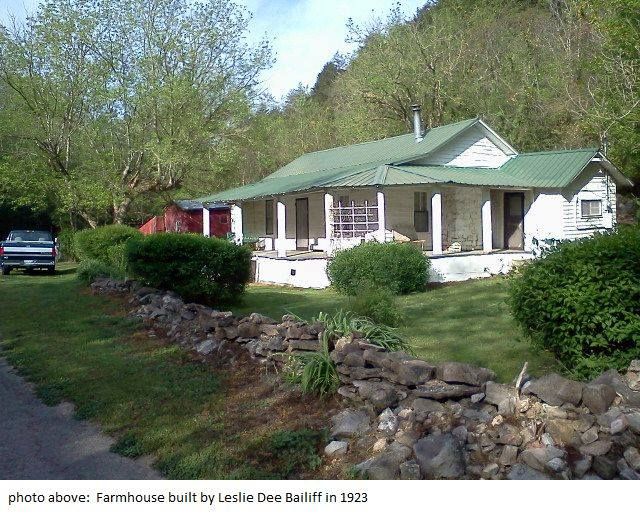
Leslie Dee “L.D. ” Bailiff, born on June 27, 1884, purchased the farm from his parents in 1925. He and his wife Amanda Helen Tramel built the farmhouse in 1923 that continued to serve the family for almost a century. Leslie and Amanda had four children.
Their son, Charlie Bailiff, was born on December 29, 1911. He served in World War II in the 365th Field Artillery, participating in campaigns across Europe and Japan. After his honorable discharge, he married Mary Codean Barrett, and they had a daughter, Sandra Jean Bailiff, born February 3, 1948.
Charlie purchased the farm from his parents in 1950 and also expanded the farm to 70 acres with the purchase of a neighboring tract of land in the same year. Charlie was well known as both a carpenter and dedicated farmer throughout his life.
Sandra Bailiff married Danny Bandy from Smithville in October 1965. She lived briefly in Texas while Danny served in the United States Army at Fort Bliss. Sandra died tragically in an automobile accident at age 25.
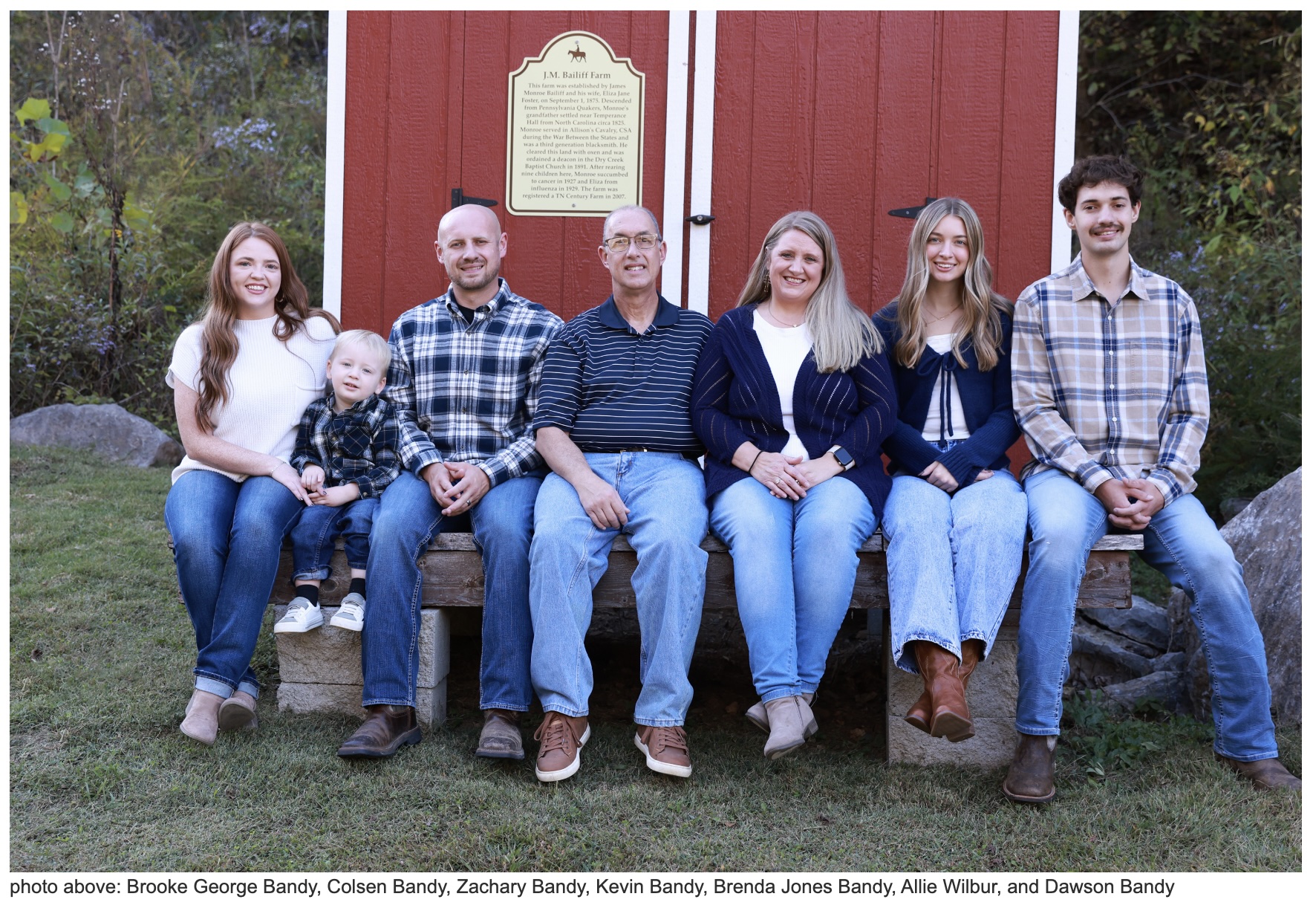
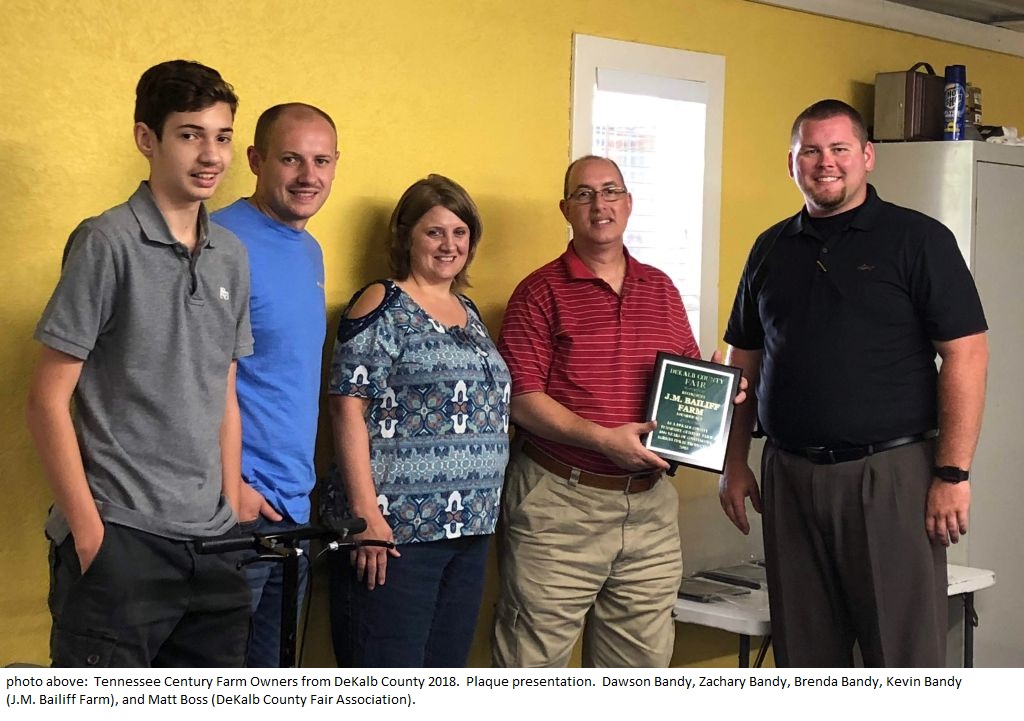
Kevin Bandy, their son and the great-great-grandson of James Monroe, took ownership of the farm in 2004 after purchasing it from his grandmother. In addition to living on the farm, Kevin manages an office of a local community bank. He and his wife Brenda Jones have two sons, Zachary and Dawson.
Zachary Bandy married Brooke George, and they have a son, Colsen Bandy, who represents the seventh generation of the Bailiff family in Possum Hollow. The farm has shifted focus in recent years toward timber production while preserving agricultural traditions.
Recognition and Legacy
The J.M. Bailiff Farm was designated a Tennessee Century Farm in 2007 and is one of eleven Century Farms in DeKalb County. It stands as a symbol of enduring family dedication, rural heritage, and the continuity of American farm life through generations.
The farm reflects a rich tapestry of history—from 18th-century Quaker beginnings, through Civil War struggles and Reconstruction, to modern stewardship—anchored by its connection to the social and spiritual fabric of the Dry Creek community.
As it marks 150 years, the J.M. Bailiff Farm honors its forebears and embodies the unbroken lineage of family, faith, and land stewardship that continues to define its legacy in Tennessee.
J.M. Bailiff Farm
132 year old Bailiff Farm joins ranks of Tennessee's Century Farm Program
In the decade following the end of the Civil War, many farms were established as people began to resume a normal life and rebuild their lives and make the land productive again. Confederate veteran and former prisoner of war, James Monroe Bailiff established a 52 ½ acre farm about five miles from Dowelltown in 1875. Bailiff was in Company A, Allison’s Battalion of Confederate Calvary. He was wounded at the Battle of Chickamauga in September of 1863 and later captured by Union troops. In the Spring of 1864, he was released. Family history indicates that the Bailiff family owned slaves prior to the war, but they were freed in 1854 by James Monroe’s grandfather.
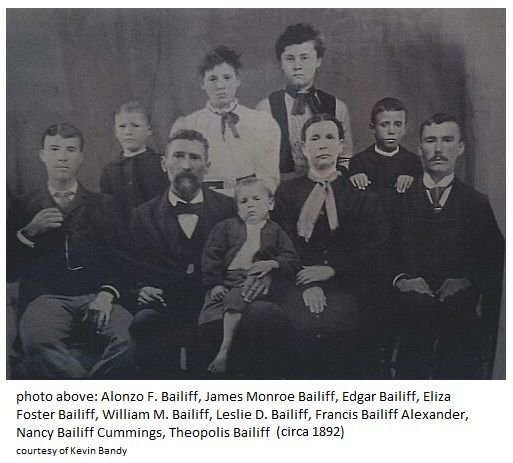
James and his wife, Eliza Jane Foster, had nine children. The family raised wheat, corn, cattle, horses, mules, oxen, pigs, chickens and kept bees. James also served as a deacon of the Dry Creek Missionary Baptist Church during the 1880s.
In 1925, James’s and Eliza’s son, Leslie Dee Bailiff became the second generation to own the farm. Married to Amanda Tramel, the couple had four children. Their names were Charlie, Talphia, Mairene and Louelle. During his ownership, the farm produced corn, tobacco, cattle, horses, mules and chickens.
The third generation to own the property was Charlie Bailiff, who acquired the farm in 1950. During World War II, Charlie served in the 365th Field Artillery and drove an ammunition truck carrying 105mm shells to the front line. He served in France, Belgium, Germany and in Japan during the United States’ occupation. In 1946, he was honorably discharged as a corporal from Camp Chaffee, Arkansas. Under Charlie’s ownership, the farm produced tobacco, corn, cattle, chickens, horses and mules. Charlie married Mary Codean Barrett and they had one daughter, Sandra Jean Bailiff.
In 2004, the great, great grandson of James and Eliza, Kevin Bandy, acquired the farm. He and his wife Brenda have two sons, Zachary and Dawson. The farm house built in 1923 by Leslie Dee Bailiff continues to be used by the family. Today, timber is the primary product of this Reconstruction-era farm.
Photo above: J. M. Bailiff, the founder of the farm and his family | Admitted to TN Century Farm program April 20, 2007 | Above press release printed in the "Smithville Review" July 18, 2007
Plowshares and Swords
Tennessee Farm Families Tell Civil War Stories, published 2013
click here to scroll PDF on a mobile device | (1MG PDF)
J.M. Bailiff Farm celebrates 140 years
On September 1, 1875 James Monroe Bailiff purchased a 52 acre farm in Possum Hollow in the Dry Creek community of DeKalb County from John and Mary Lyles. Shortly afterwards he moved there with his wife, Eliza Foster Bailiff, and their three children, William, Alonzo, and Robert.
The Bailiff family descended from Pennsylvania Quakers. Records indicate that they were in Chester County, Pennsylvania as early as the 1740’s. They then migrated to Orange County, North Carolina in the 1760’s and again to Smith County, Tennessee by the 1820’s. James Monroe Bailiff was born to a second generation blacksmith and farmer, Thomas Isaac Bailiff, and his wife, Nancy Bates Bailiff. Nancy was a niece to Colonel James Tubb of Liberty.
The Bailiff family resided in the Temperance Hall community until the death of Thomas Isaac Bailiff in 1852. Isaac was a member of the Temperance Hall Masonic Lodge, and he instructed members to assist Nancy in selecting and purchasing a property in Alexandria at his death. Nancy moved with the younger children, including Monroe, to the Lower Helton community of Alexandria with the new purchase.
War broke out between the Southern and Northern states in 1861. James Monroe and his older brother, Columbus, joined the Confederate cavalry in February 1863. He was only a few months away from his eighteenth birthday when he was wounded and captured during the battle of Chickamauga, Georgia in September. He was released from Union prison in Louisville, Kentucky in the spring of 1864 and returned home to Alexandria unable to perform further military service.
He met Eliza Foster from the Wolf Creek community, and they married in October 1865. The war was over, and they took up farming in nearby Laurel Hill. It was there that their eldest children were born.
James Monroe and Eliza Bailiff moved from Laurel Hill to Possum Hollow in September 1875. Only two other families resided there at that time, the Braswell and Alexander families.
The Bailiff’s cleared the land with oxen, completed a log home, and took up farming and blacksmithing. By 1887, the Bailiff family included nine children.
One of those children was Leslie Dee Bailiff, born 1884. He married Amanda Helen Tramel in 1908. Leslie Dee and Amanda built a second home on the property in 1923. And, they purchased the farm from his parents in 1925. It was there that they raised four children, Talphia, Charlie, Mairene, and Louelle Bailiff.
Charlie Bailiff was born to Leslie Dee and Amanda Bailiff in December 1911. He and the other Bailiff children attended Possum Hollow School and received as good an elementary education as was common at the time.
War broke out again in 1941 with the bombing of Pearl Harbor in Hawaii. Charlie was drafted into the 365th Field Artillery Battalion. He served in both Europe and Japan.
After the war, Charlie Bailiff married Mary Codean Barrett of the Round Top community near Cottage Home. They were wed in March 1946 and soon had a daughter in February 1948, Sandra Bailiff. Charlie and Codean purchased the farm from his parents in 1950. Also that same year, they purchased an adjoining 18 acres from a neighbor enlarging the farm to a total of 70 acres.
As did many others, Charlie obtained a vocational education in carpentry via the G.I. Bill. While earning a living building homes in the area, he continued to raise livestock on the farm for the better part of the next thirty years.
Sandra Bailiff attended elementary school in Dowelltown and graduated from DeKalb County High School in 1966. She married Danny Bandy from Smithville in October 1965. Sandra lived briefly in Texas to be near her husband while he served in the United States Army at the U.S. Air Defense Center at Fort Bliss. Danny was honorably discharged in February 1968 and their son, Kevin, was born in December. The Bandy's were residing in Smithville when tragedy struck, and Sandra was killed in an automobile accident in July 1973.
Kevin Bandy graduated from DeKalb County High School in 1987 and from Tennessee Technological University in 1992. He married Brenda Jones from Battle Creek, Michigan in July 1994. With the birth of their two sons, Zachary in 1995 and Dawson in 2004, the sixth generation on the Bailiff farm in Possum Hollow became a reality.
Charlie Bailiff died in July 2001, and Kevin purchased the farm from his grandmother, Codean, shortly before her death in 2004.
The J.M. Bailiff Farm was officially certified as a Tennessee Century Farm in April 2007 with the farmhouse built in 1923 still in use by the family. And with the arrival of September 1, 2015 the farm celebrates 140 years of continuous ownership by the Bailiff family.
written by Kevin Bandy for the Tennessee Century Farm Program
Local Brothers Take Part in Battle
Monroe and Columbus Bailiff take part in Battle of Snow's Hill
Deeply divided over secession, DeKalb County furnished men for both the Confederate and Union armies during the war. With a population of about 10,500 in 1860, including approximately 1000 enslaved people, DeKalb was home to 25 manufacturing establishments. In the spring of 1863, several engagements took place around the county’s oldest town, Liberty, located on a turnpike to Nashville (now US 70). Local brothers J. Monroe and Columbus Bailiff took part in one of those battles (Snow’s Hill) as members of Confederate Col. R.D. Allison’s Cavalry Squadron. The brothers later fought at the Battle of Chickamauga, where Monroe was wounded and Columbus took ill with typhoid fever. Nursed back to health by a local family, the brothers were soon captured by Union forces and imprisoned in Louisville. Still unwell by the spring of 1864, the brothers were released, and they returned to DeKalb County. Ready to rebuild his life, Monroe married Eliza Foster, and in 1875 they purchased 52 acres along a wooded hillside in the Dry Creek community to begin their own farm (now a Tennessee Century Farm). Monroe, Eliza, and their children are shown here. Two Tennessee Civil War Trails markers tell additional stories about DeKalb’s Civil War and Reconstruction history, including the bitter divisions that continued for years after the war.
Published on facebook by Tennessee Civil War National Heritage Area on June 1, 2018
DeKalb County Fair Recognizes Century Farms
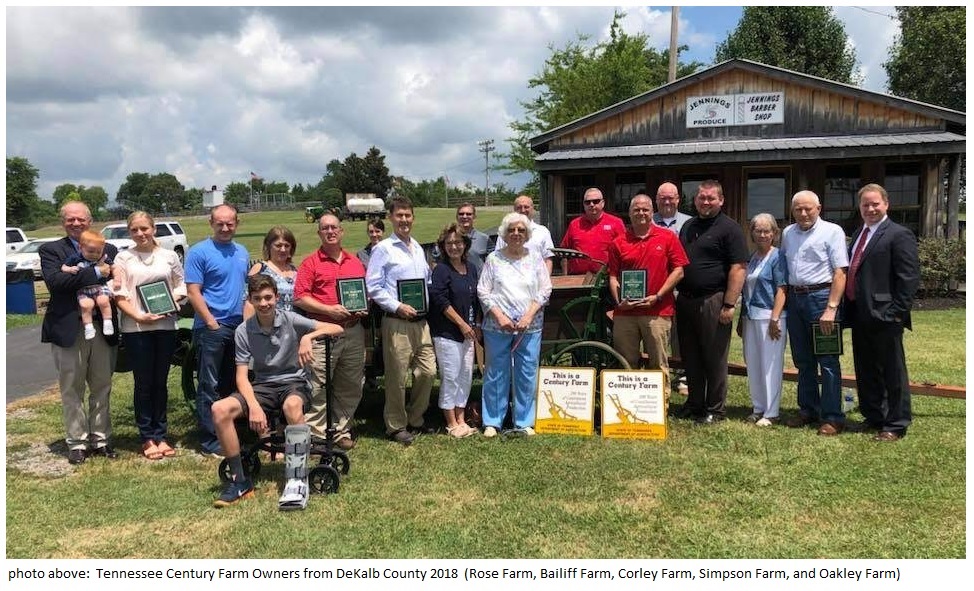
2018 DeKalb County Fair Recognizes Century Farms
The DeKalb County Fair Association invited the families of DeKalb County's Century Farms to the Lion's Club building at the fairgounds for a luncheon in Alexandria today.
Those in attendance were Chad Simpson (Simpson Farm), Ruth Corley and family (Corley Farm), John Rose and family (Rose Farm), Jimmy Oakley and family (Oakley Farm), and Kevin Bandy and family (Bailiff Farm).
Also in attendance was Tim Stibling (DeKalb County Mayor), Donnie Green (Tennessee Farm Service Agency), Johnny Barnes and Leigh Fuson (DeKalb County UT Extension Office).
Two farms were recognized as having reached the 200 years milestone. They were the Corley Farm (founded 1815) and the Simpson Farm (founded 1816).
The Rose Farm was recognized as having been founded in 1874. The Oakley and Bailiff Farms were both founded in 1875. The Stevens-Manning Farm was founded in 1892. The family of the Stevens-Manning Farm was unable to attend the event today.
Matt Boss with the DeKalb Fair Association spoke briefly regarding the farm families and their contributions to the county through the years.
July 17, 2018
Demolition of our 95 year old house
Moving back to the farm
Moving back to Possum Hollow meant tearing down our 95 year old farmhouse to make way for a new house. My family and I have a lot of memories in that old house. It was a difficult decision to make, but one that had to be made. We were sad to see it go, but excited for the future and moving back to the farm.
J.M. Bailiff Farm marks 145 years
click here to scroll PDF on a mobile device | (1MG PDF)
2023 TN Century Farm Luncheon at the DeKalb County Fair
Bailiff, Rose, and Oakley Farms
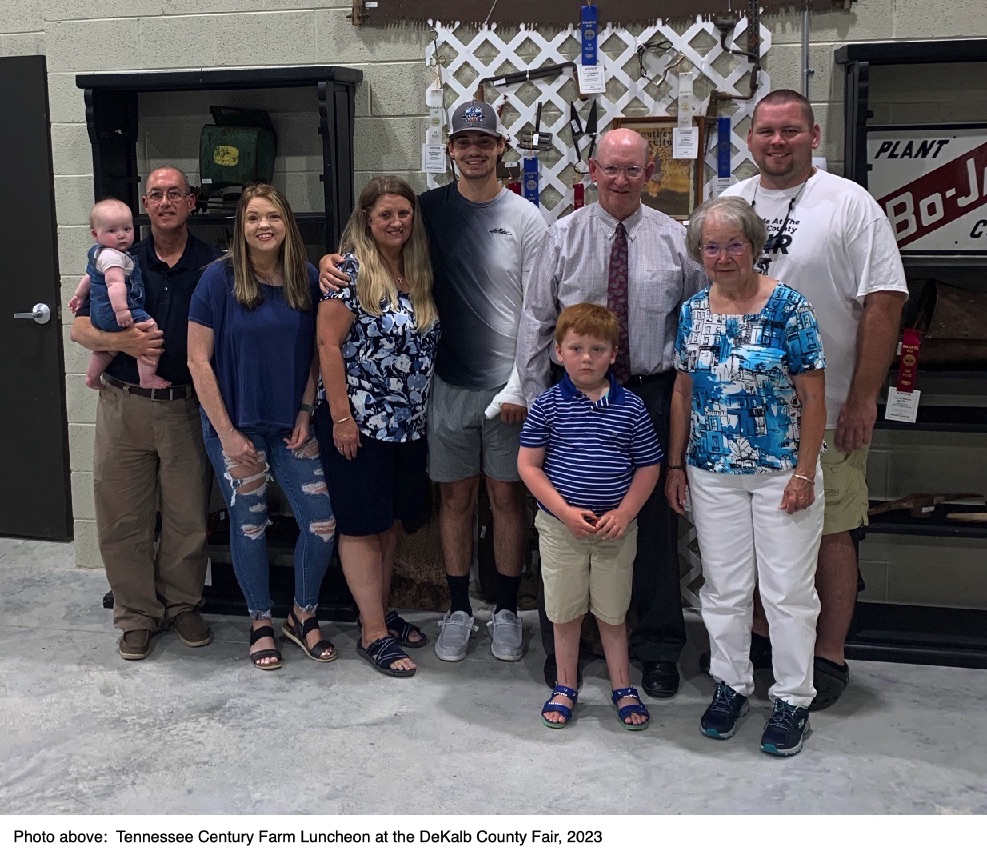
2024 TN Century Farm Luncheon at the DeKalb County Fair
J.M. Bailiff Farm

The Bailiff Farm Through The Years
James Monroe (J.M.) Bailiff’s DeKalb County farm dates back 133 150 years and has become one of the valued members of Tennessee’s Century Farm Program. The time-honored farm is located in Possum Hollow on Dry Creek in DeKalb County, Tennessee. It once was owned by John and Mary Lyles.
In the decade following the Civil War (1835), many farms were established as persons began resuming normalcy by establishing their homesteads and farmlands. Confederate veteran and former Prisoner of War, James Monroe Bailiff, established a 152 52 1/2-acre farm, located five miles from Dowelltown, Tennessee.
Bailiff was a private in Company A, Allison’s Battalion of Confederate Calvary. Wounded at the Battle of Chickamauga in September, 1863, he was later captured by Union troops in the spring of 1864 and later was released. According to DeKalb County Historian, Thomas G. Webb, “Family history indicates that the Bailiff family owned slaves prior to the Civil War (which lasted for several years), but they were freed in 1854 by James Monroe’s grandfather, Thomas Bailiff.”
Webb further wrote, “Wounded in Chickamauga, the bullet that hit Monroe was still on his side when he died many years later.” According to history, he “was wounded on the right side by a ball from an Enfield rifle – the ball went through two ribs – disabling him.” Monroe returned home and married Eliza on October 6, 1865.
James and Eliza Jane (nee. Foster), had nine children. The local family raised wheat, corn, cattle, horses, mules, oxen, pigs, chicken and bees, which was kept close to the barn. James also served as a deacon of the Dry Creek Missionary Baptist Church during the 1880’s 1890's. In retrospect, James was born on December 2, 1845.
Their son, Leslie Dean Dee Bailiff, became the second generation to own the farm in 1925. He, and his wife Amanda, were the parents of four children – Charlie, Talphia, Mairene and Louelle. Throughout his ownership, the farm produced corn, tobacco, cattle, horses, mules and chickens.
The third generation of farm ownership went to Charlie Bailiff in 1950. During World War II, Charlie served in the 365th Field Artillery and drove an ammunition truck, which carried 105mm shells to the front lines. Overall, he served in Germany, France, Belgium, and Japan during the occupation by the United States. In 1946, he was honorably discharged as a corporal from Camp Chaffee, Arkansas. Throughout this time and under Charlie’s leadership, the farm again produced cattle, chickens, corn, tobacco, horses and mules. Charlie later married Mary Codean Barrett and they had one daughter, Sandra Jean Bailiff.
The proteaginous of this article, James Monroe Bailiff, succumbed to cancer on May 8, 1927. He is buried in the Snow Hill Baptist Cemetery adjacent to his wife, who was buried there on January 22, 1928 1929.
Updating to 2004, Kevin Bandy, the great-great grandson of James and Eliza, acquired the Dry Creek farm. He and his wife, Brenda, have two sons – Zachary and Dawson.
The farm house built in 1923 by Leslie Dee Bailiff continues to be used by the family and continued to be used by the family for almost 100 years. Today, timber is the primary product of this Reconstruction-era farm.
In a letter to the Tennessee State Board of Pension Examiners dated April 14, 1916, William M. Bailiff (son of Monroe Bailiff) writes: “He is getting very old. His locks have been beset by the snows of more than four-score winters – but he hopes to live a few years longer in his younger days, when the North and the South were arrayed against each other. He faced the cannon's mouth for his loyalty to the South – our Dixieland. He followed Lee and Johnston and Forrest, our great generals of the South and fought with an army of the bravest men that the world has ever known. He helped accomplish some of the most illustrious deeds of valor and heroism we shall ever know. He has always stood gallantly by the Democrat party, and labored conscientiously for its welfare. And before the reaper from across the river of time shall call him away, I would be glad to see the great state of Tennessee help the old man financially in his declining years.”
There is no record of any financial retrieval for James Monroe Bailiff. (He did indeed receive a Confederate pension from the state of Tennessee.)
(The Tennessee Century Farms Program was created in 1975 by the Tennessee Department of Agriculture as part of the Bicentennial celebration. The focus of the program is to recognize and document the families who have owned and farmed the same lands for at least 100 years.)
written by Leann Judkins for the Smithville Review, August 4, 2025. Edited by Kevin Bandy for accuracy November 19, 2025.
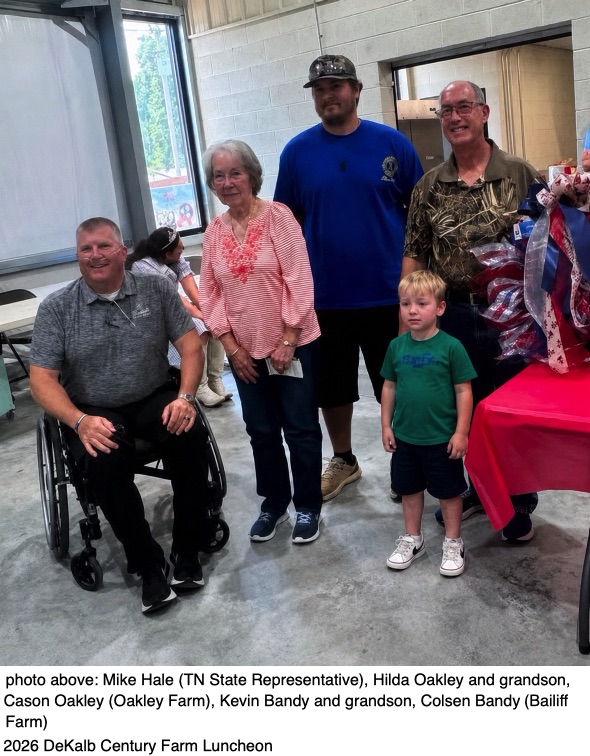
2026 TN Century Farm Luncheon at the DeKalb County Fair
J.M. Bailiff Farm
More information regarding Tennessee Century Farms can be found on their website and on facebook